TPO Roof Calculator
Lay out a fully adhered TPO roof: the sheets and the rolls they are cut from, the welded laps, the bonding adhesive and the fasteners at the edges, from GAF's EverGuard documents, and the cost at your own prices.
By Marko Visic, BSc Physics · Updated November 25, 2026
The extra at each edge is the membrane that turns up a wall or wraps the roof edge; GAF's flashing goes at least 8 in up a wall.[2] Penetrations are the pipes, vents and drains through the roof. Prices are optional and yours; nothing is sent anywhere.
To cover: 40 + 2 × 8 ÷ 12 = 41.33 ft by 30 + 2 × 8 ÷ 12 = 31.33 ft, or 41.33 × 31.33 = 1,294.87 sq ft of membrane on the roof.
Sheets: they run along the length, which takes as many rolls as the other way and less weld. Across the 31.33 ft width, each sheet laps the last by GAF's side lap, 3 ÷ 12 = 0.25 ft, so (31.33 − 0.25) ÷ (10 − 0.25) = 3.19 → 4 sheets, and the welded laps run (4 − 1) × 41.33 = 123.99 ft.[2]
Rolls: each sheet is cut from a 10 × 100 ft roll, 100 ÷ 41.33 = 2.42, so 2 whole sheets to a roll, and 4 ÷ 2 = 2 rolls, with 2 × 100 − 4 × 41.33 = 34.68 ft of roll left for flashing.[1]
Weight: a 10 ft roll of 60 mil weighs 322 lb on average, so the rolls weigh 2 × 322 = 644 lb, and the membrane 322 ÷ (10 × 100) = 0.32 lb per sq ft.[1]
Adhesive: TPO Low VOC Bonding Adhesive, rolled equally onto the deck and the underside of the membrane, 1,294.87 ÷ 120 = 10.79 to 1,294.87 ÷ 100 = 12.95 gal; bought for the second, 12.95 ÷ 5 = 2.59 → 3 pails.[2]
Fasteners and plates: at most 12 in apart around the roof's 2 × (40 + 30) = 140 ft perimeter, 140 × 12 ÷ 12 = 140, and at least 4 at each penetration, 2 × 4 = 8: together 140 + 8 = 148.[2]
How many rolls of TPO does a roof need? Count the full-width sheets across the roof, then how many come out of each roll. A 40 × 30 ft roof with 8 in at each edge takes (31.33 − 0.25) ÷ (10 − 0.25) = 3.19 → 4 sheets of GAF's 10 ft roll lapped 3 in, each 41.33 ft long.[2] A 100 ft roll gives 100 ÷ 41.33 = 2.42, so 2 whole sheets, and the roof takes 4 ÷ 2 = 2 rolls.[1]
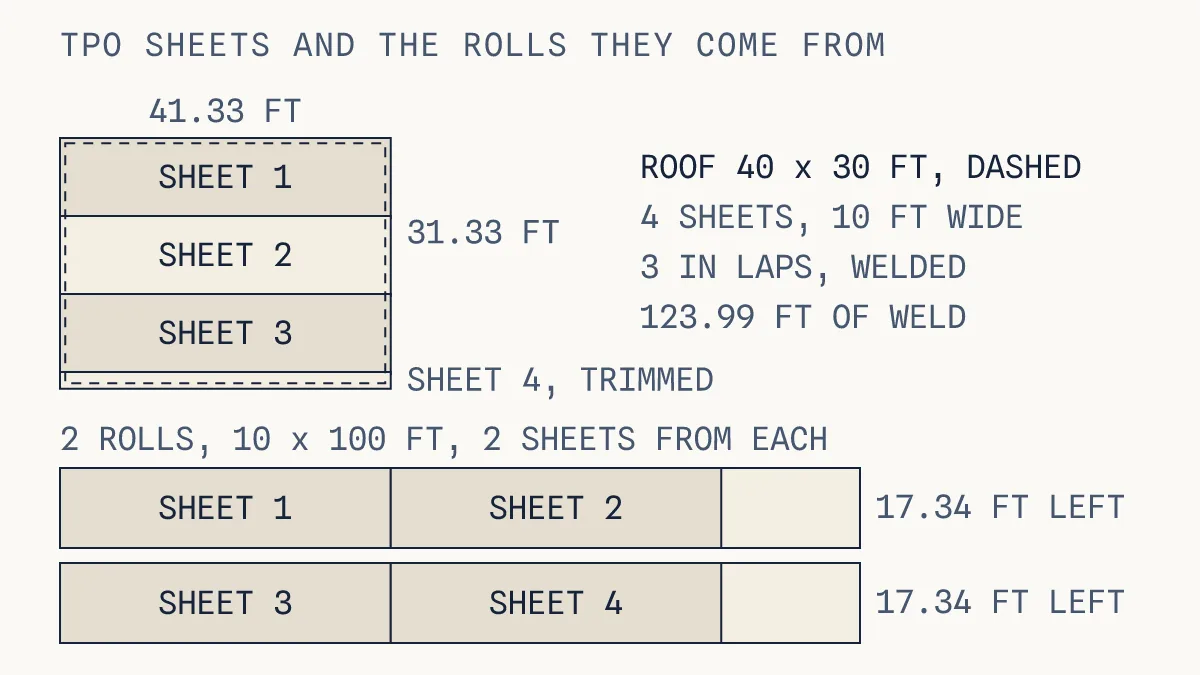
Drawing: CalculateMyRoof · CC BY 4.0 · How to reuse
How it works
Enter the roof's length and width and the extra membrane each edge takes, up a wall or over the edge. The calculator adds the extra to both sides of each dimension and lays full-width sheets along one side, each lapping the last by GAF's side lap. A sheet runs the whole way, so it has no end lap, and each one is cut from a roll: a roll gives as many whole sheets as fit in its length. By default it tries the sheets both ways and takes the way with fewer rolls; when the rolls tie, the way with less weld.
From that layout it counts the rolls and their weight, the feet of welded lap, the bonding adhesive for the membrane's area, and the fasteners and plates around the edges and at each penetration. With your prices it adds up the cost and divides it by the roof's area; with a contractor's quote it gives the quote per sq ft.
Worked example
The roof is 40 ft long and 30 ft wide, with 8 in of extra membrane at each edge: 40 + 2 × 8 ÷ 12 = 41.33 ft by 30 + 2 × 8 ÷ 12 = 31.33 ft, or 41.33 × 31.33 = 1,294.87 sq ft of membrane on the roof.
With 10 ft rolls and the 3 in side lap, 3 ÷ 12 = 0.25 ft, sheets along the length take (31.33 − 0.25) ÷ (10 − 0.25) = 3.19 → 4 sheets with (4 − 1) × 41.33 = 123.99 ft of welded lap.[2] Each roll gives 100 ÷ 41.33 = 2.42, so 2 whole sheets, and 4 ÷ 2 = 2 rolls cover the roof, with 2 × 100 − 4 × 41.33 = 34.68 ft of roll left for flashing.[1]
Laid the other way, along the width, the sheets would number (41.33 − 0.25) ÷ (10 − 0.25) = 4.21 → 5, 100 ÷ 31.33 = 3.19, so 3 whole to a roll, and 5 ÷ 3 = 1.67 → 2 rolls: as many rolls, but (5 − 1) × 31.33 = 125.32 ft of weld, so the calculator runs them along the length.[1][2]
A 10 ft roll of 60 mil weighs 322 lb on average, so the rolls weigh 2 × 322 = 644 lb, and the membrane 322 ÷ (10 × 100) = 0.32 lb per sq ft.[1] TPO Low VOC Bonding Adhesive takes 1,294.87 ÷ 120 = 10.79 to 1,294.87 ÷ 100 = 12.95 gal, or 12.95 ÷ 5 = 2.59 → 3 pails.[2]
Around the roof's 2 × (40 + 30) = 140 ft perimeter, fasteners and plates at most 12 in apart number 140 × 12 ÷ 12 = 140, and the 2 penetrations take 2 × 4 = 8 more: 140 + 8 = 148 in all.[2]
TPO roll sizes and weights
GAF makes EverGuard TPO in five roll widths, every roll 100 ft long, and in three thicknesses; the weights below are the data sheet's averages per roll.[1]
| Roll | Covers | 45 mil | 60 mil | 80 mil[1] |
|---|---|---|---|---|
| 12 x 100 ft | 1,200 sq ft | 307 lb | 386 lb | 504 lb[1] |
| 10 x 100 ft | 1,000 sq ft | 256 lb | 322 lb | 420 lb[1] |
| 8 x 100 ft | 800 sq ft | 204 lb | 257 lb | 336 lb[1] |
| 6 x 100 ft | 600 sq ft | 153 lb | 194 lb | 252 lb[1] |
| 5 x 100 ft | 500 sq ft | 128 lb | 162 lb | 210 lb[1] |
Thicker membrane carries a longer guarantee: GAF offers guarantees on eligible systems of up to 20 years for 45 mil, 25 for 60 mil and 30 for 80 mil.[1] A wider roll covers the same roof with fewer sheets, so there are fewer laps to weld.
Laps, welds and end laps
GAF's adhered manual calls for full-width rolls in the field and at the perimeter, with each sheet lapping the last by at least 3 in; a red line printed on the membrane marks the lap.[2] The laps are heat welded, and a good weld is a film-tearing bond 1 to 1.5 in wide, made on the field seams with an automatic hot-air welder.[2] Where three sheets meet at a T-joint, 60 mil and thicker membrane needs a welded cover patch, and every cut edge of the reinforced membrane is sealed.[2]
End laps are where sheets meet end to end, on a roof longer than a roll in both directions. The manual details them for fleece-back membrane only: the ends are butted and an 8 in strip of smooth membrane is welded over the joint.[2] The calculator lays out roofs where each sheet runs the whole way in one piece and says so when a roof is too long for that.
Bonding adhesive
For smooth TPO, the bonding adhesive is rolled onto the deck and the underside of the membrane in equal coats. GAF rates each adhesive by the installed surface it covers per gallon, and notes that the rate varies with the substrate.[2]
| Adhesive | Per gallon | Per pail |
|---|---|---|
| TPO Low VOC Bonding Adhesive | 100 to 120 sq ft | 600 sq ft, 5 gal[2] |
| #1121 TPO Bonding Adhesive | 50 to 70 sq ft | 300 sq ft, 5 gal[2] |
| TPO 3 Square Low VOC Bonding Adhesive | 50 to 70 sq ft | 300 sq ft, 5 gal[2] |
The calculator gives the gallons at both ends of the rate and buys pails for the lower one, which takes more adhesive. GAF's spray adhesives come in canisters, which the calculator doesn't count.[2]
Fastening the edges
An adhered roof is still fastened at its edges. In GAF's first option, the membrane is secured at the perimeter, at the base of walls and curbs and at every penetration with fasteners and plates no more than 12 in apart, and at least 4 at each penetration.[2] The calculator counts them around the roof's perimeter and at the penetrations you enter; walls and curbs inside the roof add more. Flashing runs at least 8 in up any wall; if the roof membrane itself turns up a wall, enter at least that much extra at that edge.[2]
What does a TPO roof cost?
We found no public primary source for what TPO costs to buy or install, so this page prints no price. The calculator works from yours: the rolls, the adhesive pails, the fasteners and anything else, added up and divided by the roof's area, and a contractor's quote divided the same way. What US households paid for roofing jobs of every kind is on the roof replacement cost calculator, from the Census Bureau's housing survey.
HUD's capital-needs tool plans 15 years of useful life for a TPO or vinyl roof.[3]
TPO roof formulas
- To cover (sq ft) = (length + 2 × edge ÷ 12) × (width + 2 × edge ÷ 12), lengths in ft and the edge in in.
- Sheets = (side across − lap) ÷ (roll width − lap), rounded up; each sheet, and each welded lap between two sheets, is as long as the side the sheets run along.[2]
- Sheets per roll = 100 ft ÷ sheet length, rounded down; rolls = sheets ÷ sheets per roll, rounded up.[1]
- Adhesive (gal) = sq ft to cover ÷ coverage per gallon; pails = gallons ÷ 5, rounded up.[2]
- Fasteners and plates = perimeter (ft) × 12 ÷ spacing of 12 in, rounded up, plus 4 per penetration.[2]
- Weight (lb) = rolls × roll weight; cost per sq ft = total ÷ (length × width).
Common questions
How much does TPO roofing cost per square foot?
That comes from your prices: the calculator adds up the rolls, adhesive, fasteners and other items you price and divides the total by the roof's length times its width. We found no public primary source for TPO prices, so the page prints none.
How much does a roll of TPO cover?
GAF's rolls cover their width times 100 ft, so a 10 ft roll is 1,000 sq ft.[1] Laid with the 3 in side lap, a full roll adds (10 − 0.25) × 100 = 975 sq ft of roof.[1][2]
How much does a 10 x 100 roll of TPO cost?
We found no public primary source for TPO roll prices. Enter your supplier's price per roll and the calculator adds it to the rest of the job.
How long will a 60 mil TPO roof last?
HUD's capital-needs tool plans 15 years for a TPO roof.[3] GAF's guarantee on an eligible 60 mil system runs up to 25 years; a guarantee sets what GAF will cover, not how long the roof will last.[1] The roof lifespan page compares other coverings.
How thick is 60 mil TPO?
A mil is a thousandth of an inch, so 60 ÷ 1,000 = 0.06 in.
Is TPO cheaper than shingles?
We found no public primary source that compares their prices, and the two suit different roofs: the 2024 IRC lets single-ply membranes such as TPO go down to 1/4:12 (R905.12.1), while asphalt shingles need 2:12 (R905.2.2).[4] The shingle calculator does the same count for a steeper roof.
Does this work for PVC roofing?
For the layout, yes: GAF's adhered manual sets the same 3 in lap for its PVC as for its TPO.[2] The roll sizes, weights and adhesives here are the TPO ones, though, and we found no public primary source for PVC prices either.
Methodology & sources
The roll sizes, weights and guarantees are from GAF's EverGuard TPO data sheet; the laps, welds, adhesives and fastening from GAF's EverGuard TPO & PVC adhered roofing systems manual, read on GAF's site. The useful life is HUD's and the minimum slopes the 2024 IRC's. The layout is geometry, calculated with the formulas above; the engine is tested on every build. The calculator covers fully adhered smooth TPO; other makers' rolls, laps and adhesives differ, so check the documents for the product you buy.
Sources
- [1] GAF. EverGuard TPO Smooth 80/60/45 mil data sheet (COMEG876-0726). Features, Product Data. Retrieved Nov 19, 2026. gaf.com
- [2] GAF. EverGuard TPO & PVC Adhered Roofing Systems Manual (v3.0). Field Practices C.4.d, C.6.f and C.6.h (FP-6, FP-7), Field Practices C.6.i and C.6.j (FP-7), Installation Guidelines E.3.b, E.3.c and E.11.a (IG-3, IG-7), Installation Guidelines E.3.d and E.11.b (IG-3, IG-7), Installation Guidelines E.9.a (IG-6), Installation Guidelines F.5.a (IG-7), Product Listings, Bonding Adhesives (PL-5). Retrieved Nov 19, 2026. gaf.com
- [3] U.S. Department of Housing and Urban Development. CNA e-Tool Estimated Useful Life Table. 3.3.4. Retrieved Oct 9, 2026. hud.gov
- [4] International Code Council. 2024 International Residential Code, Chapter 9: Roof Assemblies (Oct 2026 version). Sections R905.2.2, R905.12.1. Retrieved Oct 28, 2026. codes.iccsafe.org
Change log: first published November 25, 2026.
Related
- Rubber roof calculator
- Flat roof slope calculator
- Low-slope roofing
- Roof load calculator
- How long does a roof last
By Marko Visic, BSc Physics. Updated November 25, 2026.