How Long Does a Roof Last?
How long each covering lasts by one named source, and a check for your own roof's remaining years.
By Marko Visic, BSc Physics · Updated November 25, 2026
Drawing: CalculateMyRoof · CC BY 4.0 · How to reuse
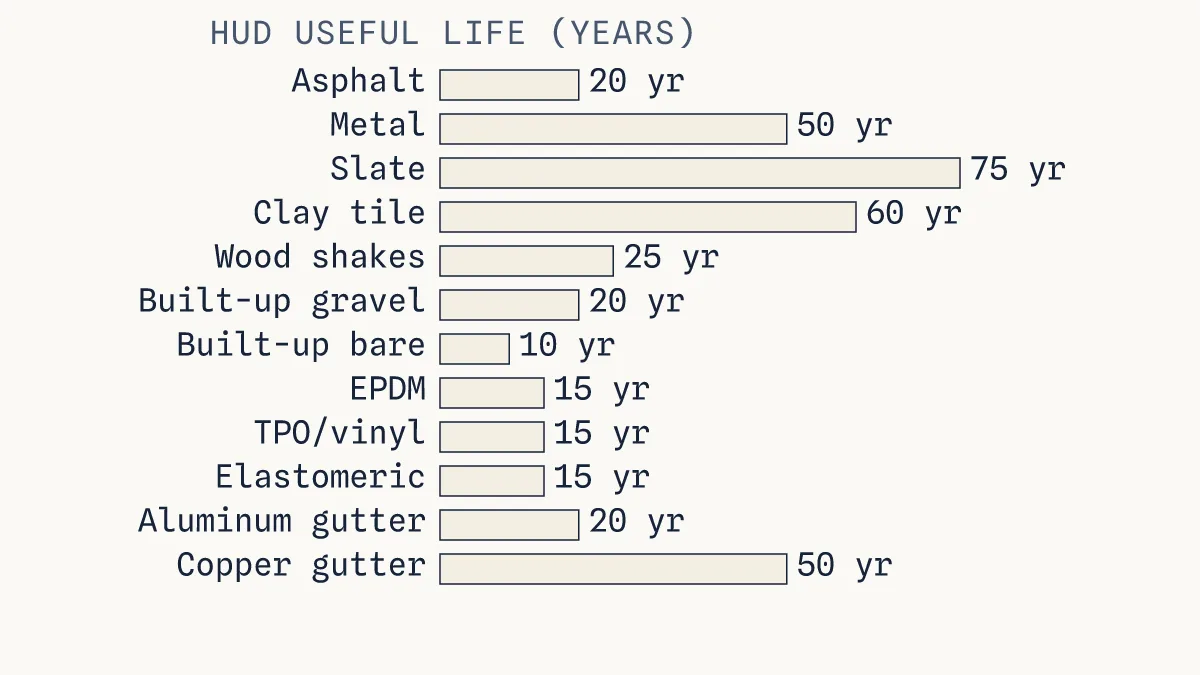
How long a roof lasts depends on its covering. By HUD's planning estimates, roofs run from 10 years for a bare built-up roof to 75 years for slate, with asphalt shingles at 20 years and metal at 50 years.[1] These are asset-planning figures, not warranties.
Useful life by covering (HUD)
HUD publishes an estimated useful life for each roofing material in its capital-needs table, for budgeting a replacement.
| Covering | HUD estimate [1] |
|---|---|
| Asphalt shingles | 20 years [1] |
| Metal | 50 years [1] |
| Slate | 75 years [1] |
| Clay or concrete tile | 60 years [1] |
| Wood shingles and shakes | 25 years [1] |
| Built-up with gravel | 20 years [1] |
| Built-up without gravel | 10 years [1] |
| EPDM | 15 years [1] |
| TPO or vinyl | 15 years [1] |
| Elastomeric (cool) coating | 15 years [1] |
| Aluminum gutters | 20 years [1] |
| Copper gutters | 50 years [1] |
Check your roof's remaining years
Pick a covering and the year it was installed. The check adds HUD's estimate to that year to give the planning date its useful life runs out.
Enter the year the roof was installed.
How long does each roof last?
- Asphalt shingles: 20 years.[1]
- Metal: 50 years.[1]
- Clay or concrete tile: 60 years.[1]
- Slate: 75 years, the longest-lived covering in HUD's table.[1]
What HUD does not tell you
HUD's table is one covering per row, so a few things it does not split out:
- Asphalt shingles are not separated by type, so architectural and three-tab share one estimate.
- Modified bitumen and thatch have no row, so this page does not give a figure for them.
- Warranties are not in it: each manufacturer sets its own terms by product, so check the warranty on your own covering.
Methodology & sources
The estimates are HUD's Estimated Useful Life table, verified against the source in October 2026; every build checks each page against those verified facts.[1] The remaining-year check adds the estimate to the year you enter; it is a planning date, not a prediction of failure.
Sources
- [1] U.S. Department of Housing and Urban Development. CNA e-Tool Estimated Useful Life Table. 3.3.4. Retrieved Oct 9, 2026. hud.gov
Change log: first published November 25, 2026.
Related
- Metal roof vs shingles
- Roof repair or replace calculator
- Slate roof calculator
- Roof pitch calculator
- Roof area calculator
By Marko Visic, BSc Physics. Updated November 25, 2026.