Roof Heat Cable Calculator
How much de-icing cable a roof edge, its gutters and downspouts take by the maker's own layout, how many circuits a cut-to-length run needs, and what it draws.
By Marko Visic, BSc Physics · Updated November 25, 2026
Overhang runs from the wall to the roof edge. Between two rows, pick the larger one. Valleys: the total length along them. Downspouts: each one's height.
Roof edge: 40 × 2.8 = 112 ft of cable in the zig-zag, and 40 × 0.5 = 20 ft to carry it down into the gutter.[1]
Gutter: 40 × 1 = 40 ft, one run of cable.[1]
Downspouts: (10 + 1) × 2 × 1 = 22 ft, one run down each.[2]
Cable: 112 + 20 + 40 + 22 = 194 ft in all.
FrostGuard: the longest is 100 ft, so 194 ÷ 100 = 1.94 → 2 cables at least, each on its own 6 ft cord and plug.[1] Each branch circuit needs 30 mA equipment or 5 mA personnel ground-fault protection.[1]
Power: at 8 W/ft (in ice or snow at 32°F), 194 × 8 = 1,552 W, or 1,552 ÷ 120 = 12.93 A at 120 V.[1]
Energy: 1,552 ÷ 1,000 = 1.55 kWh for each hour on; 1.55 × 24 = 37.2 kWh for 24 hours.
Roof clips: 40 ÷ 7 = 5.71 → 6 packages of 10, or 40 ÷ 35 = 1.14 → 2 boxes of 50, for the zig-zag.[2]
How much heat cable do I need for my roof? Multiply the roof edge by Raychem's feet of cable per foot of edge for your overhang, then add half the edge to reach the gutter, the gutter itself, and each downspout's height plus 1 ft.[1][2] For 40 ft of edge over a 12 in overhang, 40 ft of gutter and 2 downspouts 10 ft tall: 40 × 2.8 = 112, 40 × 0.5 = 20, 40 and (10 + 1) × 2 = 22, so 112 + 20 + 40 + 22 = 194 ft.[1][2]
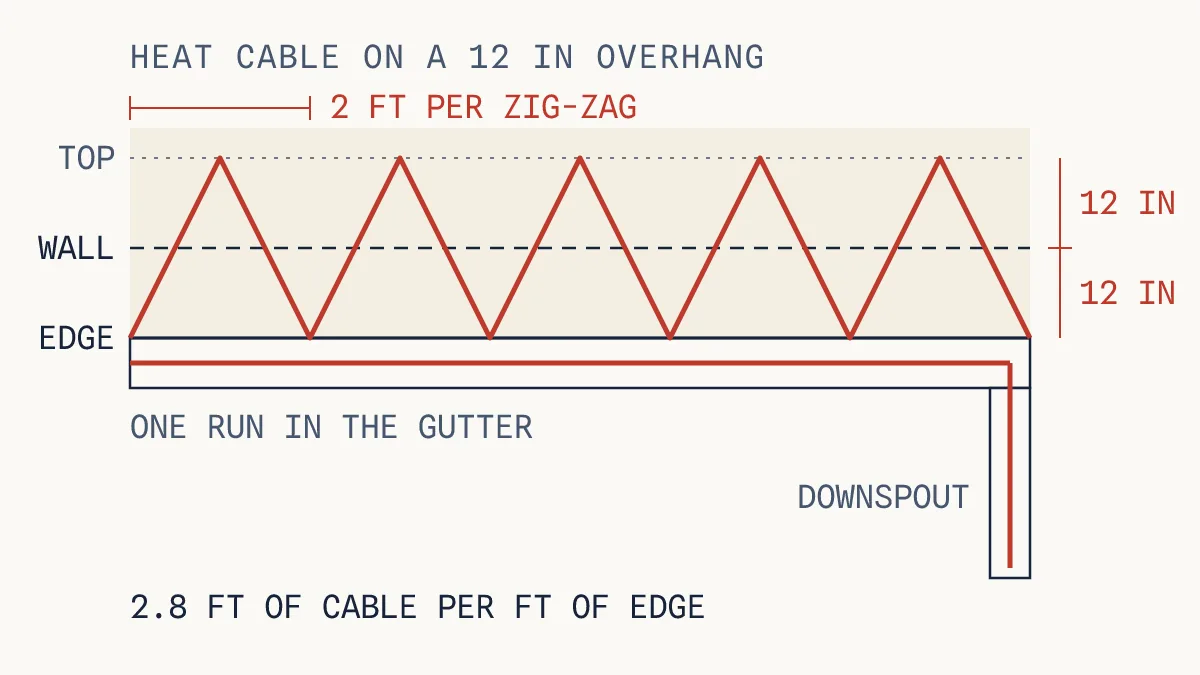
Drawing: CalculateMyRoof · CC BY 4.0 · How to reuse
How the layout works
Raychem lays roof cable in a zig-zag along the eave, 2 ft wide per triangle, climbing until it is approximately 12 in past the exterior wall, over the heated part of the house.[2] The deeper the overhang, the taller each triangle and the more cable per foot of edge. The data sheet gives that length for three kinds of roof:[1]
| Eave overhang | Shingle or standard roof | Standing seam, 18 in seams | Standing seam, 24 in seams[1] |
|---|---|---|---|
| None (gutter required) | 2 ft | 2.5 ft | 2 ft[1] |
| 12 in | 2.8 ft | 2.8 ft | 2.4 ft[1] |
| 24 in | 3.8 ft | 3.6 ft | 2.9 ft[1] |
| 36 in | 4.8 ft | 4.3 ft | 3.6 ft[1] |
For an overhang between two rows, take the larger row: the triangles then still reach past the wall. The table stops at 36 in.[1]
Gutters, downspouts and valleys
The roof extension, 0.5 ft of cable per foot of edge, carries the roof run down into the gutter, or forms drip loops past the edge where there is no gutter.[1] The gutter itself takes one run of cable along its length; for gutters 5 to 6 in wide, 2 runs, and for anything wider than 6 in the maker asks you to call.[1]
Each downspout takes its height plus 1 ft.[2] Where the downspout sits in the middle of the run, the cable goes down and back up, which doubles it.[1] The WinterGard Wet guide also calls for two runs where water flow is high, where winter temperatures often fall below 0°F, or where a tee isn't convenient.[2] Valleys get a double run two-thirds of the way up, which the worksheet counts as the valley's length times 1.33.[2]
Cable on the roof is not always needed: if ice dams don't form on your roof, the guide says cable in the gutters and downspouts alone may be enough, and the calculator has a switch for that.[2]
Worked example
The roof edge is 40 ft over a 12 in overhang on a shingle roof, with 40 ft of standard gutter and 2 downspouts at the ends, each 10 ft tall.[1] The zig-zag takes 40 × 2.8 = 112 ft and the roof extension 40 × 0.5 = 20 ft.[1] The gutter takes 40 × 1 = 40 ft and the downspouts (10 + 1) × 2 × 1 = 22 ft.[2] In all, 112 + 20 + 40 + 22 = 194 ft of cable.
In FrostGuard, which comes in fixed lengths up to 100 ft, that is 194 ÷ 100 = 1.94 → 2 cables at least, each on its own plug, drawing 194 × 8 = 1,552 W in ice or snow at 32°F.[1]
In 120 V WinterGard Wet on a 20 A breaker, a circuit takes at most 125 ft for a 0°F start-up, so 194 ÷ 125 = 1.55 → 2 circuits.[2] Their kits add 2 × 1 + (2 + 0) × 0.5 = 3 ft, so the cable to buy is 194 + 3 = 197 ft, and 197 ÷ 125 = 1.58 → 2 circuits still.[2] At 8 W/ft it draws 197 × 8 = 1,576 W.[2]
Circuits for cut-to-length cable
A breaker carries a shorter run for a colder start-up, so the run depends on the lowest temperature the system will switch on at. The WinterGard Wet guide says to design for the shorter 0°F length and use the 32°F one only to save circuits; the number of circuits is the cable's length over the longest run, rounded up, and the breaker the smallest that fits.[2]
| Cable | Breaker | Start-up at 0°F | Start-up at 32°F[2] |
|---|---|---|---|
| H612, 120 V | 15 A | 100 ft | 125 ft[2] |
| H612, 120 V | 20 A | 125 ft | 165 ft[2] |
| H612, 120 V | 30 A | 150 ft | 200 ft[2] |
| H622, 208 to 240 V | 15 A | 200 ft | 250 ft[2] |
| H622, 208 to 240 V | 20 A | 250 ft | 320 ft[2] |
| H622, 208 to 240 V | 30 A | 305 ft | 400 ft[2] |
Each circuit's power connection kit adds 1 ft of cable, each splice or tee kit 2 ft, and each end seal 0.5 ft; an end seal comes in every power connection kit and every splice and tee kit.[2] The plug-in H908 connection is a 15 A, 120 V kit with 27 mA ground-fault protection built in, for circuits up to 125 ft.[2] FrostGuard needs none of this: each cable comes finished with its own 6 ft cord and plug, in 6, 12, 18, 24, 36, 50, 75, and 100 ft lengths, and only the 120 V version is for roofs and gutters.[1]
Power and running cost
Both cables are rated at 8 W per foot in ice or snow at 32°F.[1][2] So 100 ft draws 100 × 8 = 800 W, which is 800 ÷ 1,000 = 0.8 kWh for every hour it is on.[1] The calculator multiplies the hours you enter by your own price per kWh; this page prints no electricity prices, since your utility sets them.
When to switch it on
The WinterGard Wet guide names three ways to run a system. A manual switch needs someone watching the weather. An ambient thermostat keeps it on whenever the air is below freezing; Raychem's AMC-F5 is set at 40°F.[2] An automatic controller switches it on when it senses both precipitation and cold and off when the precipitation stops or the air warms above freezing; Raychem's are set at 38°F.[2] The guide's point is the trade-off: off when it is needed, ice forms; on when it isn't, the power is wasted.[2]
What heat cable does not do
Raychem describes WinterGard Wet as designed to provide a continuous path for melt water, not to clear accumulated snow
.[2] It won't stop snow sliding off the roof, which takes snow guards, and the guide covers normal winters only: for snowfalls of 9 in or more with temperatures below 0°F, the maker asks you to call.[2] Cable keeps a drain open; what makes ice dams form, and the fixes in the attic, are on the ice dams guide.
Ground-fault protection
Every circuit of either cable needs ground-fault protection. For FrostGuard the data sheet calls for 30 mA equipment or 5 mA personnel protection on each branch circuit.[1] For WinterGard Wet the guide requires a ground-fault breaker with a 27 or 30 mA trip level, which it says national electrical codes require too; the installation falls under Article 426 of the National Electrical Code.[2] The maker's reason is fire: a damaged cable can arc without tripping an ordinary breaker.[2]
Roof heat cable formulas
- Roof zig-zag (ft) = roof edge × the table's feet per foot for the roof and overhang.[1]
- Roof extension (ft) = roof edge × 0.5.[1]
- Gutter (ft) = gutter length × runs (2 runs in a 5 to 6 in gutter).[1]
- Downspouts (ft) = (height + 1) × downspouts × runs in each.[2]
- Valleys (ft) = length along the valleys × 1.33.[2]
- Circuits = cable ÷ the longest circuit, rounded up; recheck after the kit allowances.[2]
- Watts = cable × 8; kWh per hour on = watts ÷ 1,000.[2]
Common questions
How do I calculate how much heat tape I need for my roof?
Take the roof edge times the maker's feet per foot for your overhang, plus half the edge, the gutter, and each downspout's height plus 1 ft.[1][2] The example above comes to 194 ft: 112 + 20 + 40 + 22 = 194.
How far up the roof should heat cable go?
To approximately 12 in past the exterior wall, over the heated part of the house, so the triangles get taller as the overhang gets deeper.[2]
How long should roof heating cables be left on?
Raychem's guide leaves that to the control: a thermostat runs them whenever the air is below freezing, and an automatic controller only while it also senses precipitation, switching them off when it stops or the air warms above freezing.[2]
How much electricity does roof heat cable use?
At 8 W per foot in ice or snow, 100 ft uses 800 ÷ 1,000 = 0.8 kWh an hour.[1] The calculator turns your hours and price into the cost.
Do I need heat cable on the roof or only in the gutters?
If ice dams don't form on your roof, Raychem's guide says the gutters and downspouts alone may be enough.[2]
How many roof clips do I need?
For the zig-zag, one package of 10 Raychem clips per 7 ft of roof edge, or a box of 50 per 35 ft.[2]
Methodology & sources
The layout, the per-foot table and the rules for gutters, downspouts and valleys come from Raychem's FrostGuard data sheet and WinterGard Wet design guide, published by Chemelex and read in November 2026. The circuits, kit allowances, clips and controls are the WinterGard Wet guide's. Lengths, circuits and watts are calculated on the page with the formulas above, and the engine is tested on every build. Other makers print their own tables, which can differ; this page uses Raychem's because it prints the whole method.
Sources
- [1] Chemelex. Raychem FrostGuard preassembled heating cable data sheet (RAYCHEM-DS-H59485-FrostGuard-EN-2504). p. 1, Product Overview and catalog numbers, p. 2, Ground-Fault Protection, p. 2, specifications, p. 3, formula and roof extension note, p. 3, Length of Cable Per Foot of Roof Edge (ft), 18 inch Seam, p. 3, Length of Cable Per Foot of Roof Edge (ft), 24 inch Seam, p. 3, Length of Cable Per Foot of Roof Edge (ft), Standard Roof, p. 3, notes. Retrieved Nov 18, 2026. cdn.chemelex.com
- [2] Chemelex. Raychem WinterGard Wet roof and gutter de-icing guide (RAYCHEM-DG-H56804-WinterGard-EN-2609). p. 5, Overview, p. 8, Other Considerations, p. 8, Sloped Roof, Shingle Roof, and Table 1, p. 12, Valleys; p. 35, worksheet D and E, p. 14, Downspouts; p. 35, worksheet I, p. 23, Table 8, p. 23, Table 8; p. 36, worksheet step 4, p. 24, Determining the Number of Circuits, p. 24, Step 5 and warning; p. 5, Codes and Approvals, p. 25, Table 9; p. 33, Appendix A, p. 33, Appendix A, pp. 20-21, Step 3, Control; Tables 5 and 6. Retrieved Nov 18, 2026. cdn.chemelex.com
Change log: first published November 25, 2026.