How Much Snow Can a Roof Hold?
What the snow on your roof weighs, from FEMA's figures, and where to find what your roof was built for.
By Marko Visic, BSc Physics · Updated November 25, 2026
Drawing: CalculateMyRoof · CC BY 4.0 · How to reuse
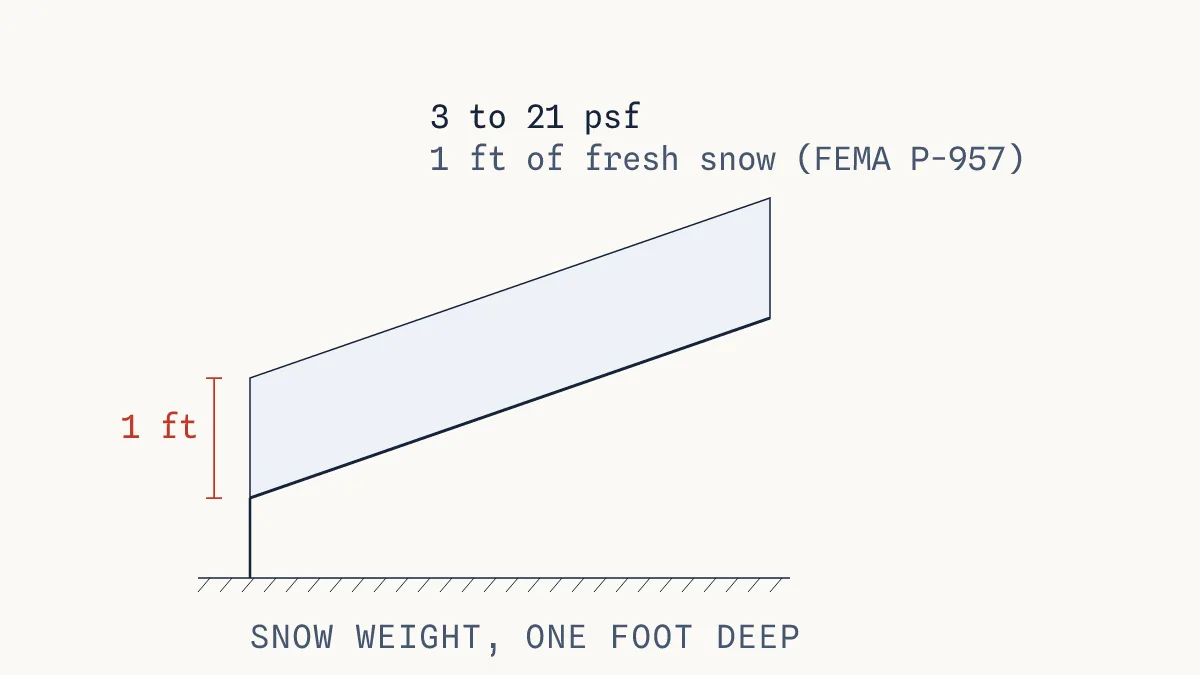
A roof does not hold a fixed number of pounds. What matters is the snow's weight against the roof's design load. Fresh snow weighs 3 psf to 21 psf per foot of depth, and ice about 5 psf per inch.[1] This page weighs the snow; the design load comes from your local code.
Weigh the snow on your roof
Enter the depth and, if you have it, the roof area. Fresh snow is given as a range because its weight depends on how wet it is; the range is never averaged into one number.
Enter a depth to weigh the snow.
What your roof was designed for
No page can tell you your roof's capacity from the outside; it depends on the structure and the ground snow load where you live. For the design figure, ask your local building department, and look up your address in the ASCE Hazard Tool, which publishes the ground snow load used by the code.
Warning signs of overload
FEMA lists the signs that a roof is carrying too much:[1]
- sagging ceiling tiles or boards, or sagging sprinkler lines or heads;
- popping, cracking, or creaking noises;
- sagging roof members or sheathing, or bowing truss chords or webs;
- doors or windows that can no longer be opened or closed;
- cracked or split wood members, or cracks in walls or masonry;
- severe roof leaks, or water pooling where it should drain on a low-slope roof.
If the signs appear, FEMA says to promptly evacuate the building and have a qualified design professional carry out a detailed structural inspection.[1]
Clearing snow
FEMA says snow removal should be done by a licensed, insured professional roofing contractor experienced in removing snow from roofs.[1] Where it can be done from the ground, that removes the risk to anyone on a hazardous roof; a non-metallic snow rake reaches steeper slopes.[1] The National Weather Service, which also recommends a roof rake,[2] puts it this way:
Long-handled devices on the market called "roof rakes" let you stand on the ground and pull the snow off the roof.
FEMA adds two rules: remove snow in the direction of the primary structural members so the remaining load stays balanced,[1] and if there is any concern the snow could cause a collapse, stop and evacuate.[1]
Methodology & sources
The weights are FEMA's figures from its Snow Load Safety Guide, verified against the source in October 2026; every build checks each page against those verified facts.[1] The calculator multiplies your depth by FEMA's per-foot or per-inch weight; the fresh-snow result stays a range. No capacity figure appears anywhere on this page.
Sources
- [1] FEMA. P-957 Snow Load Safety Guide (Jan 2013). p. 2-3, section 4.2, section 4.3, section 5.3.1, section 5.3.3. Section 4.2 list read on GPO govinfo, the official federal edition (Oct 21, 2026). Retrieved Oct 21, 2026. fema.gov
- [2] National Weather Service, Grand Rapids, MI (NOAA). Preventing Roof Ice Dams. Retrieved Oct 21, 2026. weather.gov
Change log: first published November 25, 2026.
Related
By Marko Visic, BSc Physics. Updated November 25, 2026.